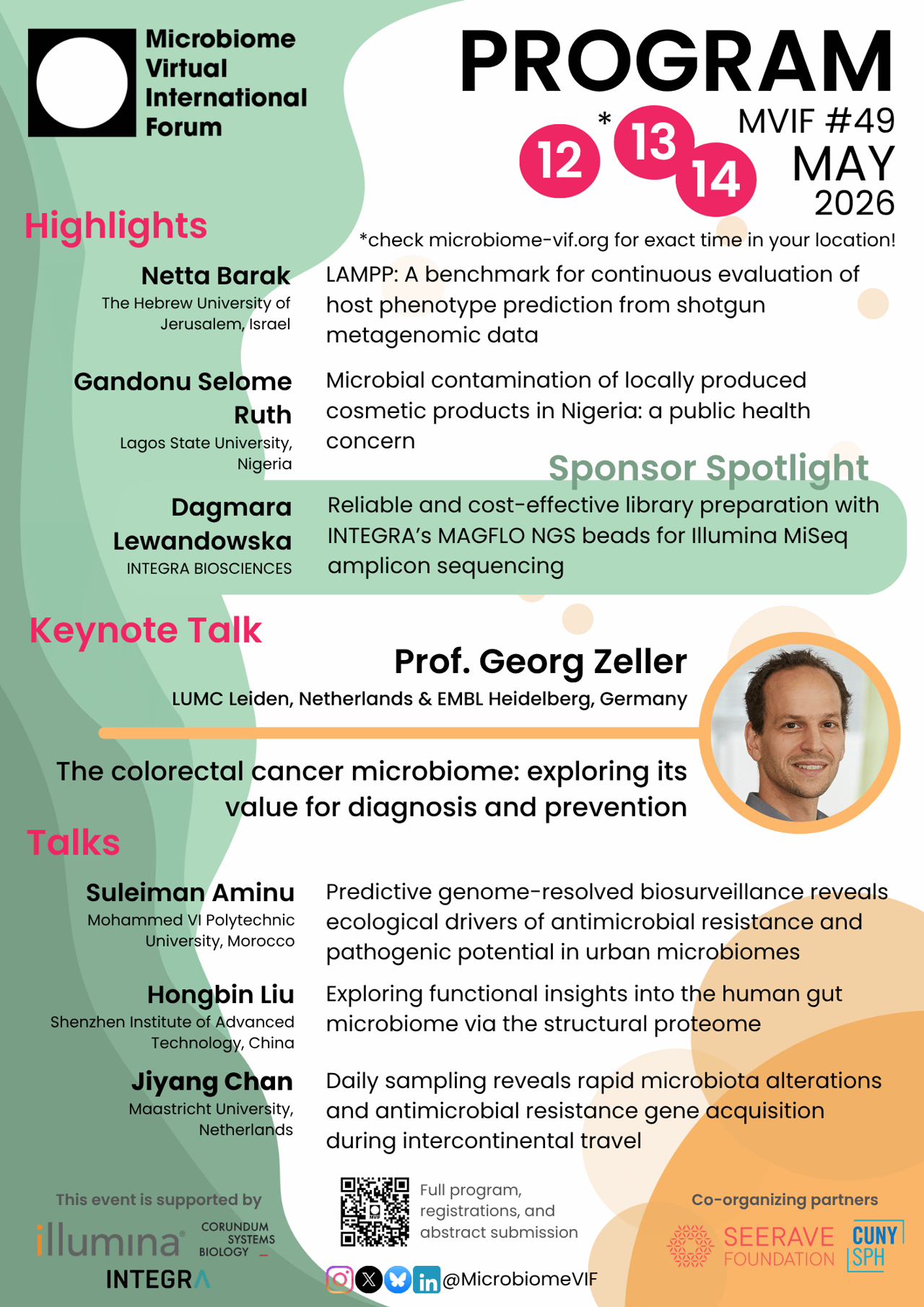

Keynote talk
The colorectal cancer microbiome: exploring its value for diagnosis and prevention
By Prof. Georg Zeller, LUMC Leiden, Netherlands & EMBL Heidelberg, Germany
Highlights
LAMPP: A benchmark for continuous evaluation of host phenotype prediction from shotgun metagenomic data
By Netta Barak, The Hebrew University of Jerusalem, Israel
Predicting host phenotypes from gut microbiome data is central to developing microbiome-based diagnostics and monitoring tools. Although many computational methods have been proposed, researchers frequently rely on traditional models such as Random Forest or Logistic Regression. This hesitancy to adopt newer methods stems from their complexity as well as the lack of standardized evaluations, as most tools are assessed on different datasets and compared against a limited set of methods. To address these challenges, we developed LAMPP — Live Assessment of Metagenomics-based tools for host Phenotype Prediction. LAMPP consists of multiple tasks covering five diverse phenotypes: inflammatory bowel disease, colorectal cancer, schizophrenia, delivery mode, and general health status. These tasks were designed to reflect real-world variation in dataset characteristics, including cohort size, class balance, technical heterogeneity, and train-test similarity (from within-cohort to cross-cohort scenarios). We evaluated a range of traditional and deep learning models, including Random Forest, XGBoost, Logistic Regression, SIAMCAT, DeepMicro, DEBIAS-M, TabPFN and fully connected neural networks. These models differ in their approaches to feature selection, normalization, and representation. Performance was measured using ROC AUC, and we additionally assessed runtime, resource usage, and usability. Our results show that prediction difficulty varies across tasks. Importantly, deep learning methods did not outperform traditional models. SIAMCAT, Random Forest, and XGBoost performed comparably, highlighting that accessible, established tools remain effective across diverse microbiome prediction scenarios. LAMPP and its leaderboard are available at https://lampp.yassourlab.com, providing a transparent platform for benchmarking emerging methods. By enabling consistent and reproducible comparisons, LAMPP fosters progress in microbiome-based phenotype prediction and supports the broader adoption of robust, accessible computational tools in microbiome research.
Microbial Contamination of Locally Produced Cosmetic Products in Nigeria: Public Health Concern
By Gandonu Selome Ruth, Lagos State University, Nigeria
The widespread use of locally produced cosmetic products in Nigeria raises significant concerns regarding microbiological safety and associated public health risks. Inadequately regulated production environments may facilitate contamination, exposing consumers to pathogenic microorganisms through daily skin application. This study evaluated the microbiological quality of commonly used locally produced cosmetic products, including creams, lotions, and oils, to determine the presence and implications of contamination. A descriptive microbiological approach was employed, using standard culture techniques for the isolation and identification of bacterial and fungal contaminants. Contamination was detected across multiple samples. Isolated organisms included Staphylococcus aureus, Pseudomonas aeruginosa, and various fungal species. The findings indicate contamination arising from poor hygiene practices, inadequate production standards, and insufficient preservative systems. The detection of clinically relevant microorganisms underscores a critical public health risk. Strengthening good manufacturing practices and regulatory surveillance is essential to ensure product safety. These findings contribute to global discussions on cosmetic microbiological safety, particularly in low- and middle-income settings.
Talks
Predictive Genome-Resolved Biosurveillance Reveals Ecological Drivers of Antimicrobial Resistance and Pathogenic Potential in Urban Microbiomes
By Suleiman Aminu, Mohammed VI Polytechnic University, Morocco
Urban infrastructures, including hospitals, ambulances, wastewater systems, and public transport, form interconnected microbial ecosystems that can facilitate the persistence and circulation of antimicrobial resistance (AMR) and pathogenic organisms. However, environmental microbiome surveillance remains largely descriptive and rarely integrates genome-resolved reconstruction with predictive ecological modeling capable of quantifying microbial stability, contamination dynamics, and pathogen-associated risk across environments. Here we present a predictive genome-resolved biosurveillance framework that combines metagenome assembly, functional annotation, ecological analysis, and machine learning–driven simulations to investigate microbial dynamics across urban infrastructures. Using the GRUMB workflow, we analyzed 767 publicly available shotgun metagenomes collected from hospital interiors, hospital sewage systems, ambulances, and public transport environments. High-quality reads were assembled into more than 10,000 metagenome-assembled genomes (MAGs), dereplicated into species-level representatives, and annotated for antimicrobial resistance genes and virulence factors. Genome-resolved abundance profiles enabled detailed ecological characterization of microbial communities and identification of pathogen-associated taxa across environments. Supervised machine-learning models accurately classified environmental origin based on microbial composition, revealing strong environment-specific microbial signatures. To investigate cross-environment microbial influence, we implemented synthetic donor–recipient mixing simulations that model contamination gradients and quantify ecological resilience, dominance relationships, and minimal detectable contamination thresholds. Our analyses reveal pronounced ecological structuring across urban microbiomes. Hospital sewage emerges as a dominant microbial donor, whereas hospital environments exhibit greater compositional stability and resilience to microbial intrusion. Functional analyses further suggest that resistance and virulence determinants form coordinated trait architectures that shape resilience–dominance trade-offs across built environments. Together, this genome-resolved and simulation-driven framework advances microbiome biosurveillance from descriptive profiling toward predictive ecological modeling. These results provide quantitative indicators for monitoring AMR dissemination and improving infrastructure-level biosurveillance within a One Health framework.
Exploring functional insights into the human gut microbiome via the structural proteome
By Hongbin Liu, Shenzhen Institute of Advanced Technology, China
The human gut microbiome contains numerous proteins whose functions remain elusive yet are pivotal for host health. Sequence-based methods often falter when attempting to infer functions within this microbial proteome due to evolutionary divergence. To address this challenge, we develop the Human Gut Microbial Protein Structure Database, which incorporates ~2.7 million predicted protein structures. Our findings reveal that structural analogy enhances the annotation of phage proteins. We detail the structural diversification of phage endolysins and confirm their potential in eliminating gut pathobionts. Furthermore, our structure-guided approach is effective in the identification of microbial-host isozymes. By employing structural alignments, we identify previously unrecognized bacterial enzymes involved in melatonin biosynthesis. Finally, we present an alignment-free method, Dense Enzyme Retrieval, based on structure-encoded protein language models for ultrafast and sensitive detection of remote homologs. Our research underscores the value of computational structural genomics in elucidating the functional landscape of the human gut microbiome.
Daily sampling reveals rapid microbiota alterations and antimicrobial resistance gene acquisition during intercontinental travel
By Jiyang Chan, Maastricht University, Netherlands
With increasing global travel, individuals are frequently exposed to new diets, environments, and microbial communities that may influence gut microbiota dynamics and facilitate the acquisition of antimicrobial resistance genes (ARGs). At present, studies characterising day-to-day microbiota and ARGs dynamics during travel are lacking. This study aimed to elucidate the short-term effects of travel on gut microbiota dynamics and ARG acquisition using a high-frequency sampling approach. A cohort of eleven Dutch travellers to Asia self-collected 254 fecal swabs before, during, and after travel for microbiota and resistome profiling. Samples were analysed using qPCR targeting clinically relevant ARGs (qnrB, qnrS and blaCTX-M) and profiled by 16S rRNA gene amplicon sequencing. Longitudinal analyses revealed pronounced inter- and intra-individual variation, with rapid shifts in microbiota composition observed within the first days of travel. An increase in Enterobacterales and a decline in commensal taxa were detected during early travel, coinciding with swift ARG acquisition. These findings underscore the key role of travel in global ARG dissemination.