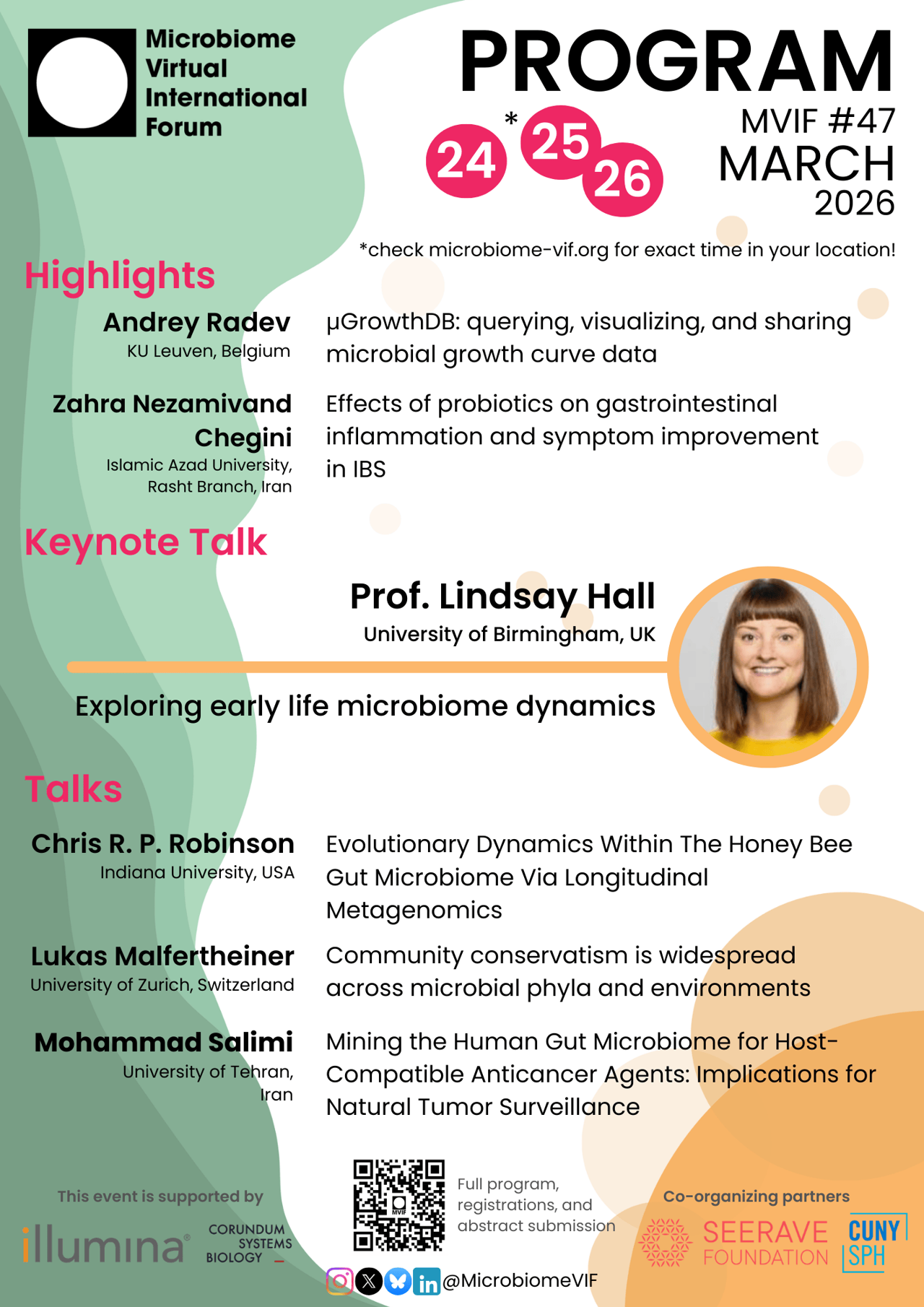

Keynote talk
Exploring early life microbiome dynamics
By Prof. Lindsay Hall, University of Birmingham, UK
Early life represents a critical window for microbiome establishment, with long-lasting implications for immune development, metabolic function, and susceptibility to infection. In this talk, I will explore how microbial interventions, such as probiotics, can support healthy microbiome development in vulnerable infant populations. I will discuss emerging evidence on how beneficial microbes and their metabolites influence host-microbe interactions, shape microbial ecology, and potentially reduce the burden of antimicrobial resistance. Finally, I will consider how a deeper mechanistic understanding of early microbial colonisation can inform the design of targeted, precision-based strategies to promote optimal health trajectories from the very beginning of life.
Highlights
μGrowthDB: querying, visualizing, and sharing microbial growth curve data
By Andrey Radev, KU Leuven, Belgium
Microbial growth curve data contain valuable information about microorganisms' physiology and metabolism. However, they are currently reported in various formats scattered across publications. A generic resource that allows querying and comparing microbial growth curve data is currently missing. For this reason, we developed μGrowthDB, an open repository designed to store, visualize, analyze, and share quantitative measurements of species abundances and metabolite profiles from monocultures and communities of known composition. μGrowthDB is designed to accommodate a range of experimental designs and measurement techniques. In addition to querying microbial growth curves by organism or metabolite, μGrowthDB supports comparative visualisation of growth curves and offers a guided data submission process intended to make data upload as easy as possible. μGrowthDB is available at: https://mgrowthdb.gbiomed.kuleuven.be/.
Effects of Probiotics on Gastrointestinal Inflammation and Symptom Improvement in IBS
By Zahra nezamivand chegini, Islamic Azad University, Rasht Branch, Iran
"Background: Irritable Bowel Syndrome (IBS) is a common functional gastrointestinal disorder characterized by abdominal pain, bloating, altered bowel habits, and low-grade inflammation. Recent evidence suggests that dysbiosis of the gut microbiota plays a central role in the pathophysiology of IBS. Probiotics, as beneficial live microorganisms, have been increasingly evaluated for their potential to modulate gut inflammation and restore microbial balance.
Objective: This mini-review aims to summarize current scientific findings regarding the effects of probiotic supplementation on reducing gastrointestinal inflammation and improving clinical symptoms in patients with IBS.
Methods: A narrative review was conducted based on studies published between 2015 and 2025, focusing on randomized controlled trials and meta-analyses evaluating probiotic strains such as Lactobacillus, Bifidobacterium, Saccharomyces boulardii, and multi-strain formulations in IBS patients.
Results: Most reviewed studies demonstrate that specific probiotic strains significantly reduce markers of intestinal inflammation, improve epithelial barrier integrity, and modulate gut microbiota composition. Clinical outcomes include reductions in abdominal pain, bloating, stool irregularity, and overall IBS severity scores. Multi-strain probiotic combinations generally show higher effectiveness compared to single-strain products.
Conclusion: Probiotic supplementation appears to be a promising, safe, and accessible therapeutic approach for mitigating gastrointestinal inflammation and improving symptoms in IBS. Further high-quality trials are needed to determine optimal strains, dosage, and treatment duration. These findings support the growing role of probiotics in gut-health–focused management strategies.
Keywords: Probiotics, IBS, Gut inflammation, Microbiome, Gastrointestinal health"
Talks
Evolutionary Dynamics Within The Honey Bee Gut Microbiome Via Longitudinal Metagenomics
By Chris R. P. Robinson, Indiana University, USA
Host-associated microbial communities are shaped by a combination of evolutionary and ecological processes. Within honey bees, broad-scale ecological dynamics of bee-associated bacteria have been extensively studied through 16S rRNA gene-based analyses. However, little is known about how honey bee-associated bacteria evolve over time. Here, we utilize longitudinally-sampled metagenomics from 12 individual honey bee colonies to quantify the ecological and evolutionary dynamics of >300 bacterial species within and across honey bee colonies over the course of one year. We find that honey bee microbial communities are highly specific to the colony of origin, and that measures of ecological and evolutionary diversity are highly stable with respect to changes in season. Adapting standard population genetic models of evolutionary processes, we find that bee-associated microbial species accumulate genetic differences within bees that can be reliably distinguished from incidents of strain replacement. By tracking high-quality polymorphic alleles, we find that bacterial species commonly generate myriad, smaller evolutionary changes, including nucleotide variants that rapidly sweep to high frequency. We further show that the majority of these sweeps cannot be explained by stochastic processes (e.g. drift). Finally, we provide evidence that while purifying selection is dominant within the honey bee gut microbiome, a large number of these allelic sweeps occur simultaneously in spatially and taxonomically distant bacterial hosts, highlighting potential convergent, adaptive responses in the honey bee gut microbiome.
Community conservatism is widespread across microbial phyla and environments
By Lukas Malfertheiner, University of Zurich, Switzerland
Evolution leaves recognizable ecological signatures. In animals and plants, closely related species tend to share traits and ecological niches - a pattern known as phylogenetic signal and niche conservatism. Whether similar principles apply to microorganisms has long remained unclear. By analyzing over one million microbiome samples from diverse environments worldwide (www.microbeatlas.org), we take the community a microbe is found in as a proxy for their realized niche. We show that phylogenetically related microbes consistently occur in more similar communities than distantly related ones. We term this global pattern community conservatism, and show it occurs in all environments and phyla analyzed - and the differences can help us to infer evolutionary patterns such as habitat specialism and generalism in different phyla. Despite immense diversity, frequent horizontal gene transfer and broad dispersal, microbial lineages retain measurable ecological continuity over evolutionary time. Community conservatism extends fundamental evolutionary concepts to the microbial world and shows promise to improve Operational Taxonomic Unit clustering in the future.
Mining the Human Gut Microbiome for Host-Compatible Anticancer Agents: Implications for Natural Tumor Surveillance
By Mohammad Salimi, University of Tehran, Iran
"Background The human microbiome secretes bioactive molecules that modulate host physiology. While commensal biosynthetic potential is established, the role of the microbiome-derived peptides in natural tumor suppression remains underexplored. Driven by the evolutionary host compatibility concept, we hypothesized that commensal peptidome harbors bioactive sequences that selectively suppress aberrant cell growth while maintaining tolerance toward healthy host epithelium. Methods We deployed a consensus-based workflow (several machine learning algorithms) to mine putative peptides sourced from the human gastrointestinal system in the AMPSphere database. Sequences were scored for physicochemical properties, predicted activity, and ease of synthesis. A 22-mer candidate was selected for synthesis and validation. Results The peptide exhibited cytotoxicity against human MCF-7 (IC50 ≈ 380 μg/ml) and murine 4T1 (IC50 ≈ 430 μg/ml) carcinoma lines, alongside antibacterial activity (E. coli, S. aureus). Crucially, unlike non-selective pore-formers, the peptide spared healthy human epithelial cells (MCF-10; IC50 ≫ 500 μg/ml, >85% viability) and caused no vascular irritation in the HET-CAM model. Implications & Future Directions This study validates high-throughput microbiome mining for therapeutic leads. Future research could focus on: • Genomic Validation: Investigate human metagenomic cohorts (e.g., TCGA, HMP) for the prevalence of the specific Biosynthetic Gene Clusters (BGCs). Correlating BGC abundance with natural tumor suppression or response to Immune Checkpoint Blockade (ICB) could establish clinical ecological relevance. • Immunogenic Cell Death (ICD) potential: Mechanistic studies can determine if peptide-mediated lysis induces ICD. Quantifying the release of Damage-Associated Molecular Patterns (DAMPs) and subsequent dendritic cell priming could clarify if these agents could act as immune-adjuvants rather than simple cytotoxins. • Causal Assessment in Gnotobiotic Models: To distinguish between direct cytotoxicity and host-immune modulation, in vivo efficacy should be evaluated using gnotobiotic mice monocolonized with peptide-producing strains versus isogenic peptide-deficient mutants. • Engineering of Live Biotherapeutics (LBPs): To circumvent pharmacokinetic instability, a synthetic biology approach could be used. Engineering commensals with inducible circuits for in situ peptide secretion would enable targeted, continuous delivery within the tumor microenvironment."